Which spot in your vineyard is the most special and why?
There are a few and they’re where you get to see/feel the whole island, and our special little piece of it…oh, there’s down in the new plantings…new ideas…a new future. Also, there’s a special space in the winery, atop a particular tank, where I can sit and just soak up what it is that we’re making and doing…and try to work out what’s the next step…we’ve a great team around us, they’re as much of the story…
2. If you link the dots in your life, which experience was the most crucial relating to how you make your wine today?
I visited a winemaker when I started studying. I expressed my want to be a winemaker. His comment was that two clean buckets and a trained monkey makes wine. What we need to know is how to grow grapes…so I studied viticulture…and now I grow wine.
3. What kind of music do you enjoy listening to when making wine in your cellar?
Neil Young; George Michael; Morrissey; Fleetwood Mac; David Bowie; Sharon Jones; Issac Hayes; Barry White; Nina Simone; Nick Cave; Ella Fitzgerald…
family time in the vineyard
4. Name a regional dish from your area, which matches best with one of your wines.
Barbequed anything…let’s make it scallops, a splash of lime juice…and a Waiheke Chardonnay….or, flashed venison and Syrah?! We live a simple and flavorsome life!
5. Name a restaurant from your recent travels around the world, which changed the way you thought about food and why?
I was in Lyon, in the old quarter, a few years back. I was young and adamant that eating offal was offensive, but I opened my mind and my palate. After that I have experienced culinary and personal delight…a closed mind helps no-one. Life is about texture…and that extends across food and wine as much.
Yarrum in Marlborough
6. If your wine would die, who or what would it come back as (person/animal)?
Wine doesn’t die, it does though change. When I’m out hiking and I’m chased/flirted with piwakawaka (our native Fantail) I feel that previous experiences are coming back to me…there’s a lifted life that flashes around me as I walk the path.
Which spot in your vineyard is the most special and why?
I personally find the “Canevaccia” vineyard very exciting. Here the “bedrock”—geologically known as Breccia di Faedo or Breccia di Masetto—turns into fertile soil and the Central-European microclimate makes a special home for the Riesling Rhenano grape. The canyon carved by the Rio Faedo in its middle enhances its unique character and the surrounding woods create an absolutely idyllic seclusion.
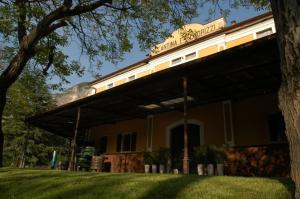
150 year old Cantina
If you link the dots in your life, which experience was the most crucial relating to how you make your wine today?
I believe that no experience in viticulture and winemaking was to inconsequential as not to have enriched me professionally. The experience in Chianti Classico just after having finished my studies was of fundamental importance, and the same goes for the subsequent experiences in different Italian regions. Equally important, furthermore, are the participation as commissioner at international wine competitions and the exchanges with other oenologists.
What kind of music do you enjoy listening to when making wine in your cellar?
I don’t listen to music in the cellar, but when I have to concentrate on a certain idea, Led Zeppelin are a great help.
4. Name a regional dish from your area, which matches best with one of your wines.
A delicious dish I only eat at the house of a few friends is polenta with snails (polenta and limoci), it pairs ever so nicely with Masetto Nero or Teroldego Reserve.
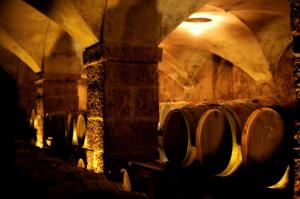
cool and deep barrel room
Name a restaurant from your recent travels around the world, which changed the way you thought about food and why?
Let’s pass on this one.
If your wine would die, who or what would it come back as (person/animal)?
The only regret when drinking Gran Masetto is that I wish I could taste it 10 – 15 – 20 years older!
Town/Country: Castellina in Chianti/ Tuscany / Italy
1. Which spot in your vineyard is the most special and why?
This is really a difficult one, but in the end I like most our Vigna Alta, where we grow Sangiovese for our Nittardi Riserva. It is beautifully surrounded by forest on 500 meters with a great south exposure. The soil has lots of rocks and schist, something that gives a great minerality and freshness to our Nittardi Riserva.
Beautiful estate in the heart of Chianti Classico
2. If you link the dots in your life, which experience was the most crucial relating to how you make your wine today?
My first experience outside of Italy was in Napa Valley, at Frogs Leap. There I learned that it is possible to create hedonistic and ripe wines that at the same time are elegant and fresh. Very influential was also a harvest in the Cote d’Or. The attention to details and respect of the terroir people have there is unique and showed me how tradition and culture are lived every day.
3. What kind of music do you enjoy listening to when making wine in your cellar?
On my playlist right now are: Devendra Banhart, Arcade Fire, Tunng, Bill Callahan, Bon Iver, Broken Social Scene, Radiohead, Sigur Ros and many more.
4. Name a regional dish from your area, which matches best with one of your wines.
A dish I love to prepare is “Peposo all’imprunetina” the Tuscan slow cooked version of “Boeuf bourguignon” with an extra dash of black pepper and of course Chianti Classico. Our Sangiovese wines go perfectly with it as the edginess of the wines combine naturally with the fleshiness of the dish.
5. Name a restaurant from your recent travels around the world, which changed the way you thought about food and why?
Joia in Milan, the only vegetarian Michelin stared restaurant in Europe. Creative Mediterranean with eastern influences. All dishes are based on an accurate research that reflect a philosophical approach to food. I enjoy eating vegetarian sometimes, and at Joia one can discover flavors one didn’t even dream of. Praiseworthy by the glass wine selection.
6. If your wine would die, who or what would it come back as (person/animal)?
It would be great to think our wine as one of these Satyr painted by Michelangelo and imagine him wandering around our forests in Chianti.
Which spot in your vineyard is the most special and why?
At the top of the Hunting Hill vineyard there is a very good view of Mate’s Vineyard, and out to the West, the Waitakere Ranges. It’s beautiful and it’s a reminder of what we are and where we are.
Mate’s Vineyard, Kumeu’s top cru
If you link the dots in your life, which experience was the most crucial relating to how you make your wine today?
In the first instance, travelling to South Australia in 1979 to study Oenology at Roseworthy College was pivotal in my career, followed by a stint in France for the 1983 Harvest. I was very fortunate to be in the right place at the right time over very many years, and had the benefit of many great mentors such as Mate Brajkovich (my father), Tom McDonald, Bob Baker, Bryce Rankine, Richard Smart, Peter Dry, Jack Schultz, Christian Moueix, Jean-Claude Berrouet, Sarah Morphew, Hugh Phillips and Kit Stevens.
What kind of music do you enjoy listening to when making wine in your cellar?
I really prefer silence in the cellar so I can listen and hear what’s going on, particularly during barrel fermentation and MLF. The sounds of the winery will also tell you if something is going wrong. And I prefer talking to my colleagues rather than shouting.
Otherwise my taste in music is fairly broad, but centred on Rock and Roll and venturing into Country, Blues, Soul and Jazz, with a smattering of Classical and Opera. My all-time favourite band is the Beatles, and I am currently listening to old John Fogerty, Rockpile, Dave Edmunds and Nick Lowe recordings.
4. Name a regional dish from your area, which matches best with one of your wines.
Fresh Crayfish from the West coast is extremely hard to get these days, but when we can we cook it quickly and serve with a simple dressing of olive oil and vinegar. It is the best accompaniment I can think of for our Chardonnay wines.
Name a restaurant from your recent travels around the world, which changed the way you thought about food and why?
Le Bernadin in New York. I ate a menu of exquisite seafood from start to finish, and it was a superb expression of the chef’s art as well as being from wonderful ingredients. It also meant that I could drink white wine right through the courses, and why not? I would like to present such a degustation menu with only our white wines (chardonnay, pinot gris and gewürztraminer) to accompany it.
If your wine would die, who or what would it come back as (person/animal)?
Grace Kelly.
Regularly clocking in the mid-90s range in ratings by wine experts
Which spot in your vineyard is the most special and why?
There is a Church of an old hermit on top of the vineyard, which has an underground cellar from 1780. In this cellar, there are amphora, which the owner of Barahonda still uses to ferment some wines. Being there and sensing how wine was made in the past is a unique experience, something which cannot be replicated.
Epistem with wax capsule
If you link the dots in your life, which experience was the most crucial relating to how you make your wine today?
Meeting and listening to the grand Monsieur Henri Bonneau in Chateauneuf, who showed me how complex, but simple, life can be. A humble mentor, who understands the virtues of balance and patience.
What kind of music do you enjoy listening to when making wine in your cellar?
At 2am in the morning the best sound is that of fermenting grape juice. Silence is golden.
Ungrafted 60 year old Monastrell
Name a regional dish from your area, which matches best with one of your wines.
The amazing paella with free range rabbit and snails!
Name a restaurant from your recent travels around the world, which changed the way you thought about food and why?
Restaurant Coure in Barcelona – owned and operated by a chef who opened it 10 years ago and seems to evolve every year. His magic makes you leave after an 8-course meal, not tired of sitting, nor stuffed from the food, but trying to remembering each and every dish. http://www.restaurantcoure.es/
If your wine would die, who or what would it come back as (person/animal)?
Argentinians have long enjoyed their well made wines in the domestic market, and the full-flavored Malbec from Mendoza entered the world stage only about 15 years ago. The bottles tried in the past have been of the juicy and brambly type or the dense and alcoholic, so I am happy to read the good news from Luis Gutierrez’ Argentina 3.0 (Robert Parker).
In it he mentions two important trends for Argentinean wines. The first “there is a global trend towards more freshness and drink-ability in wines, toward more balance, elegance, and differentiation, towards less excess and more harmony, and Argentina and Chile are no exceptions” which speaks of the Achaval FerrerFinca Altamira I enjoyed from the 2008 vintage. He continues “I think Argentina is on the way, and beside the classical regions regions in Mendoza, Lujan de Cuyo, Maipú, Cruz de Piedra, Perdriel or Agrelo, other specific and much newer sites are added to that list, mostly in the Uco Valley”, and this is where consumers, not only in Thailand, but around the world, should start experimenting with and try wines above the entry level from the various appellations Argentina offers.
Of course, you have to like the style the country offers – a dark color, intense flavors and well textured wines full of extract. But look beyond that and you find great wines with nuance and structure, and a good price.
The Altamira by the way i rate 4.0 stars (out of 5).
There is certainly a wide range of beef around for carnivores to embellish, and one of them must be the free-range Cape Grim from Tasmania.
Inside flank, lovely
Steve Craig, owner of Accidental Butcher, explained the uniqueness of the forgotten cuts and how to prepare them, while Blair Mathieson, chef at Quince – Eatery & Bar grillled them lightly and served with either anchovy butter, tarragon aioli or red pepper jam.
A Wine Garage event would not be complete without sound wine, and guests were lucky to meet and taste the organic wines from Alain Chabanon, the local hero in in Montperoux. All his wines have great varietal expression while successfully marrying mediterranean warmth with elegance.
Montperoux wines
My personal favorite was a special cut called Picanha, which is part of rump cap.
Oh yeah! I hope no wine snob will ever dismiss Australian wines again!
Of course the million bottle brand will not do it for you, but cooler Yarra and Mornington Peninsula in Victoria certainly bring forth stylish Pinots and Syrah (yes not Shiraz!). Made in minute quantities by a scientist, George Mihaly, this perfectly mature Paradigm Hill Pinot Noir 2002 could not have been better to celebrate a combo birthday dinner of friends.
George gave this magnum to a good friend, who opened the bottle a few hours before the dinner. After a first whiff, I thought this is a premier cru Burgundy from the mid 1990s, yet the wine gained more weight and fruitiness than Burgundy would allow during dinner
Thomas Henry, as you all know, was the chap who invented soda water in England in 1773! But it took some quality-minded Germans to come up with this name for new age, or better, adult sodas in 2010.
These are intensely flavored mixers for great long drinks, made from choice herbs and other ingredients.
Got these samples put into my bag at Prowein 2014. Perhaps there will be an importer interested to carry them in Thailand, since the Fevertree, the other alternative is constantly sold out.
4.5 stars for Tonic and Ginger Ale, 3.5 stars for Bitter Lemon (out of 5) and the rest of the line up I did not yet taste.